
SPREAD
Ask Price - Bid Price
1.0918 - 1.0916 = 0.0002 (2 pips)
PIPS
Ask Price - Bid Price
1.0918 - 1.0916 = 0.0002 (2 pips)
Ask Price - Bid Price
1.0918 - 1.0916 = 0.0002 (2 pips)
Ask Price - Bid Price
1.0918 - 1.0916 = 0.0002 (2 pips)
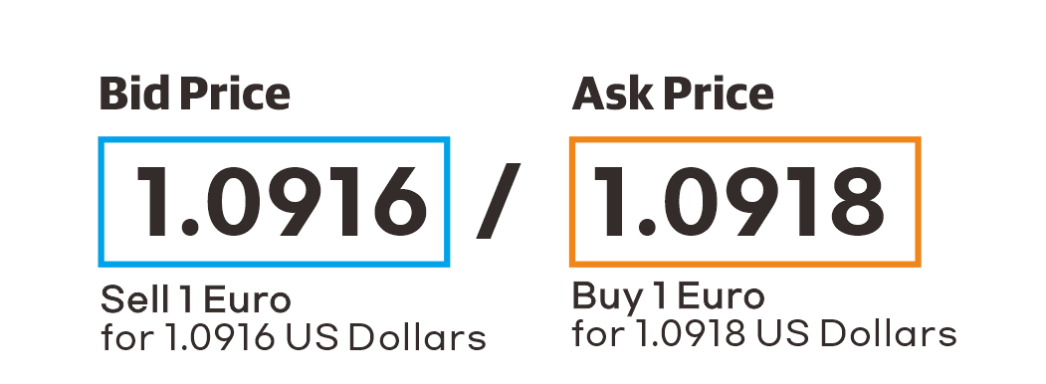
The base currency is the first currency that appears in a forex pair. This currency is bought or sold in exchange for the quote currency.
So, based on the example above, it will cost a trader 1.0916 USD to buy 1 EUR.
Alternatively, a trader could sell 1 EUR for 1.0916 USD.
The second currency of a currency pair is called the quote currency. In EUR/USD for example, USD is the quote currency.
A spread is the difference between the ask price and the bid price. In other words, it is the cost of trading.
For example, if the Euro to US dollar is trading with an ask price of 1.0918 and a bid price of 1.0916, then the spread will be the ask price minus the bid price. In this case, 0.0002.
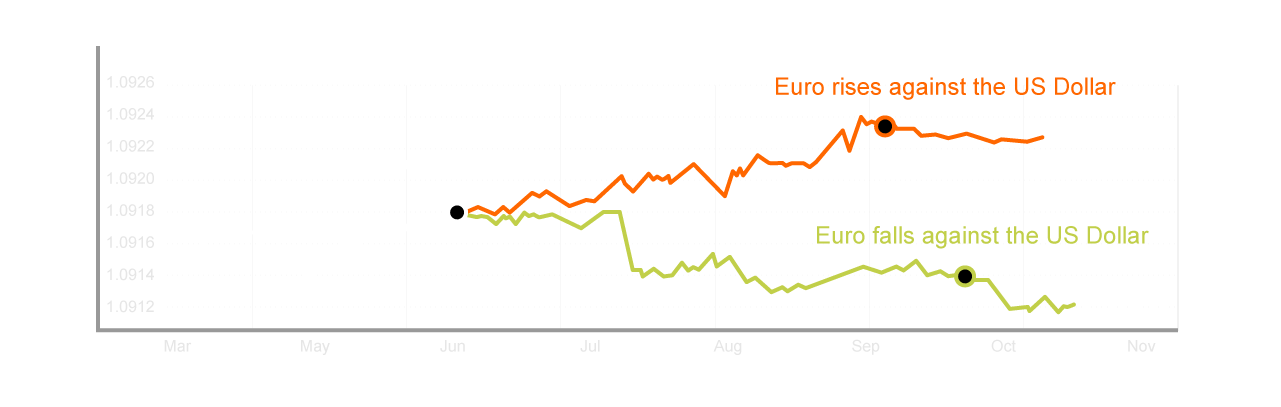
A point in price – or pip for short – is a measure of the change in a currency pair in the forex market.
The acronym can also stand for ‘percentage in point’ and ‘price interest point’. A pip is used to measure price movements, and it represents a change in a currency pair. Most currency pairs are quoted to five decimal places.
Forex prices are often quoted to four decimal places because their spread differences are typically very small. However, there is no definitive rule when it comes to the number of decimal places used for forex quotes.
On the forex market, trades in currencies are often worth millions, so small bid-ask price differences (i.e. several pips) can soon add up to a significant profit. Of course, such large trading volumes mean a small spread can also equate to significant losses.
Always trade carefully and consider the risks involved.

An FX trader is any individual who exchanges one currency for another. Individual traders commonly use different platforms to exchange foreign currency. These include banks, financial institutions, money changers, or FX brokers. Most trades are completed over-the-counter, which means that the trade is facilitated via a bank rather than a centralised entity.
PIP is the abbreviation of “point in price” or percentage in point” and it is the smallest unit of price movement in the foreign exchange market. For example, when the exchange rate of EUR/USD moves to 1.1552 from 1.1550, the currency pair has risen by 2 pips (or 0.0002).
Forex leverage is offered by brokers to enable traders to maximize their trading potential. The forex market offers higher leverage than other markets, and this attracts potential traders. Leverage allows traders to deposit small amounts and trade with high volumes. The term ultimately means borrowing money in order to increase the potential returns on a trade, but this means losses get increased too.
The difference between the ask price and bid price is known as the spread. The spread represents the cost of a transaction; the lower the spread, the lower the cost. A spread is influenced by a number of factors: the supply of the asset, the stock’s trading activity, and the total demand or interest in a particular asset.
Hedging is a technique designed to reduce the risk caused by adverse price fluctuations. Investors and traders might implement a forex hedge in order to protect their position from risk as exchange rates change. Foreign currency options are a common hedging method, and grant the trader the possibility to buy or sell at a future exchange rate.
A swap is simply an exchange of one currency for another. At a later date, the two parties who made the swap will receive their original currency back with a forward rate. The forward rate locks in a specific exchange rate and therefore acts as a kind of hedge. The swap varies significantly among different financial instruments.
Slippage refers to the difference between the requested price of a trade and the price at which it is eventually executed. Slippage is usually found when the markets are particularly volatile, and prices have moved quickly during the time it takes for the trade to be ordered and completed. Slippage can have positive and negative consequences.
Trade all major currency pairs and crosses o n live-streaming quotes..
Full access to reliable rading platforms and trade FX professionally.
Offer up to 500 times everage to magnify your investment return.
Providing global economic report by the experts
Providing the reliable investment funds/ portfolio

Past performance is not a guarantee of future return, nor is it necessarily indicative of future performance. Keep in mind investing involves risk. FX and CFDs are leveraged products that can result in losses exceeding your deposit. They are not suitable for everyone so please ensure you fully understand the risks involved. The risk of loss in leveraged foreign exchange trading can be substantial. You may sustain losses in excess of your initial margin funds. Placing contingent orders, such as "stop-loss" or "stop-limit" orders, will not necessarily limit losses to the intended amounts. Market conditions may make it impossible to execute such orders. You may be called upon at short notice to deposit additional margin funds. If the required funds are not provided within the prescribed time, your position may be liquidated. You will remain liable for any resulting deficit in your account. You should therefore carefully consider whether such trading is suitable in light of your own financial position and investment objectives.
© Copyright 2021. Creative Idea HK Limited. All Rights Reserved.